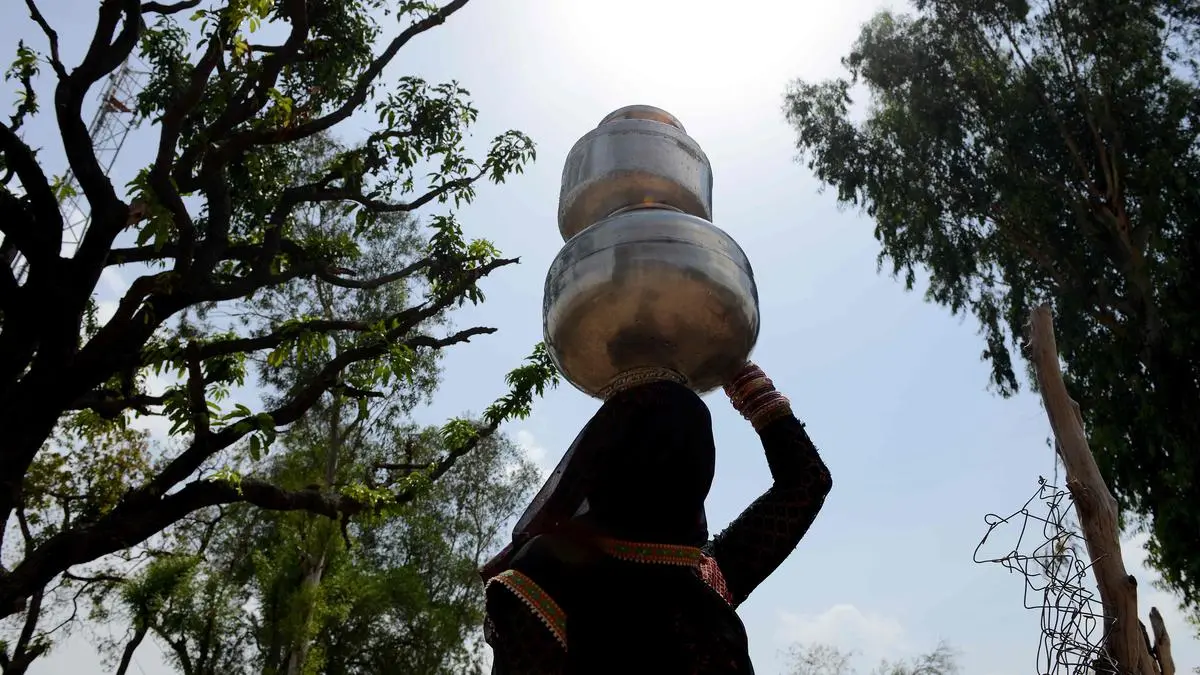
Every summer morning, long before the sun even thinks about hitting its peak, Kamlawati Yadav is already walking. In Barua village, Satna district, she navigates the dusty paths, a heavy water container balanced on her head, another gripped in her hand. Her destination? Not her own well, not a public tap, but a neighbour’s private borewell, half a kilometer away. This isn’t a morning stroll; it’s a lifeline.
The Daily Trek for Survival
Kamlawati’s village has a well, but it runs dry by April, staying parched until the monsoon arrives in late August or September. The government-installed hand pump? It offers the same disheartening result. So, Kamlawati walks. She will walk again in the evening, covering the same ground twice each day, just to bring her family of five a total of 72 litres – enough for drinking, cooking, and basic hygiene. “Getting water is the first thing I do,” she says, a quiet testament to a daily struggle that defines her existence.
Kamlawati’s daily trek isn’t unique. It’s a stark, human-shaped ripple in India’s vast water crisis – a crisis often mislabeled as simply a lack of water. But scratch beneath the surface, and you’ll find something far more complex: a profound struggle rooted in power, privilege, caste, and gender.
Beyond Scarcity: A Crisis of Inequality
For years, the narrative around India’s water woes has focused on dwindling groundwater, erratic monsoons, and climate change. These factors are undoubtedly critical. However, a deeper look reveals that the problem isn’t just about *if* there’s enough water, but *who* gets it, *how* they get it, and the embedded social hierarchies that dictate access.
National statistics paint a grim picture: over 600 million Indians grapple with high to extreme water stress, according to NITI Aayog’s Composite Water Management Index. That’s more than half a billion people facing daily uncertainty about humanity’s most basic need. Yet, this broad number often masks the specific, unequal burdens carried by different communities.
The Unseen Burden: Gender and Caste
In countless villages like Barua, the lack of accessible water disproportionately impacts women and marginalized communities. It is typically women who bear the primary responsibility for fetching water, a chore that consumes hours of their day, often leading to physical strain, missed educational opportunities for young girls, and limited participation in economic activities. Kamlawati’s story is a powerful illustration of this gendered burden, where the hunt for water becomes an all-consuming task, leaving little time or energy for anything else.
The role of caste is equally insidious. Historically, access to shared resources like village wells was often dictated by social standing. While legal discrimination has been abolished, the legacy of the caste system continues to affect access to clean, safe water. Communities deemed ‘lower caste’ often find themselves at the end of the line, or entirely excluded from communal sources, forcing them to rely on distant, unsafe, or privately controlled options. A private borewell, like the one Kamlawati relies on, might offer water, but it also reinforces dependence and highlights the failure of public systems to serve everyone equally.
Who Controls the Flow?
The ‘power’ aspect of India’s water crisis manifests in several ways. Economically privileged households can afford to dig deeper borewells, install powerful pumps, or even purchase water from private tankers, ensuring their needs are met regardless of local scarcity. This creates a stark divide between those who can buy their way out of the crisis and those who cannot.
The failure of public infrastructure also plays a crucial role. When government-installed wells and hand pumps run dry or break down due to poor maintenance, it’s the most vulnerable who suffer. This often points to a lack of political will, insufficient investment, or unequal distribution of resources and development efforts. In essence, water becomes a commodity, and access to it a reflection of social and economic status.
Looking Ahead: Solutions Beyond the Obvious
Addressing India’s water crisis requires moving beyond a purely environmental lens. While conservation, rainwater harvesting, and efficient water management are vital, they must be coupled with a robust commitment to social justice. This means ensuring equitable distribution mechanisms, strengthening public water infrastructure, and actively challenging the ingrained social inequalities that dictate who gets water and who doesn’t.
Community-led initiatives, coupled with transparent governance and accountability, can empower local populations to manage their water resources fairly. The goal shouldn’t just be to find more water, but to ensure that the water available reaches every household, irrespective of their social standing or economic means.
Why This Matters
India’s water crisis is a profound human rights issue that underpins broader challenges of public health, education, gender equality, and economic development. When a basic necessity like water is unequally distributed, it perpetuates cycles of poverty and marginalization, eroding social cohesion and denying millions their fundamental dignity. Understanding this crisis as a battle for power and equity is the first step towards building a more just and sustainable future for all.