The political landscape of Tamil Nadu, long dominated by two behemoths, has been utterly transformed. In a seismic shift that few truly predicted, actor C. Joseph Vijay’s Tamilaga Vettri Kazhagam (TVK) party swept the 2026 Assembly elections, securing a stunning 108 seats. This victory isn’t just about a new party taking power; it’s a profound fracture in the state’s political trajectory, arguably more significant than the DMK’s initial rise in 1967.
The Unthinkable Just Happened
For decades, Tamil Nadu politics has been a two-horse race, a relentless tug-of-war between the Dravida Munnetra Kazhagam (DMK) and the All India Anna Dravida Munnetra Kazhagam (AIADMK). Voters had grown accustomed to the rhythm, the rhetoric, the familiar faces. Then came the 2026 election, and with it, a political earthquake that has left seasoned observers scrambling for answers. The TVK’s emphatic win didn’t just break the duopoly; it shattered it, ushering in an era where celebrity power, direct outreach, and a fresh narrative seem to have trumped traditional political machinery.
From Superstar to Chief Minister
For years, speculation swirled around Joseph Vijay’s political ambitions. A titan of Tamil cinema, known affectionately as “Thalapathy” (Commander) to his legions of fans, Vijay commanded an almost cult-like following. His films were not just entertainment; they often carried subtle social messages, hinting at a deeper engagement with public life. His formal entry into politics with the TVK wasn’t a surprise, but the speed and scale of his ascent certainly were.
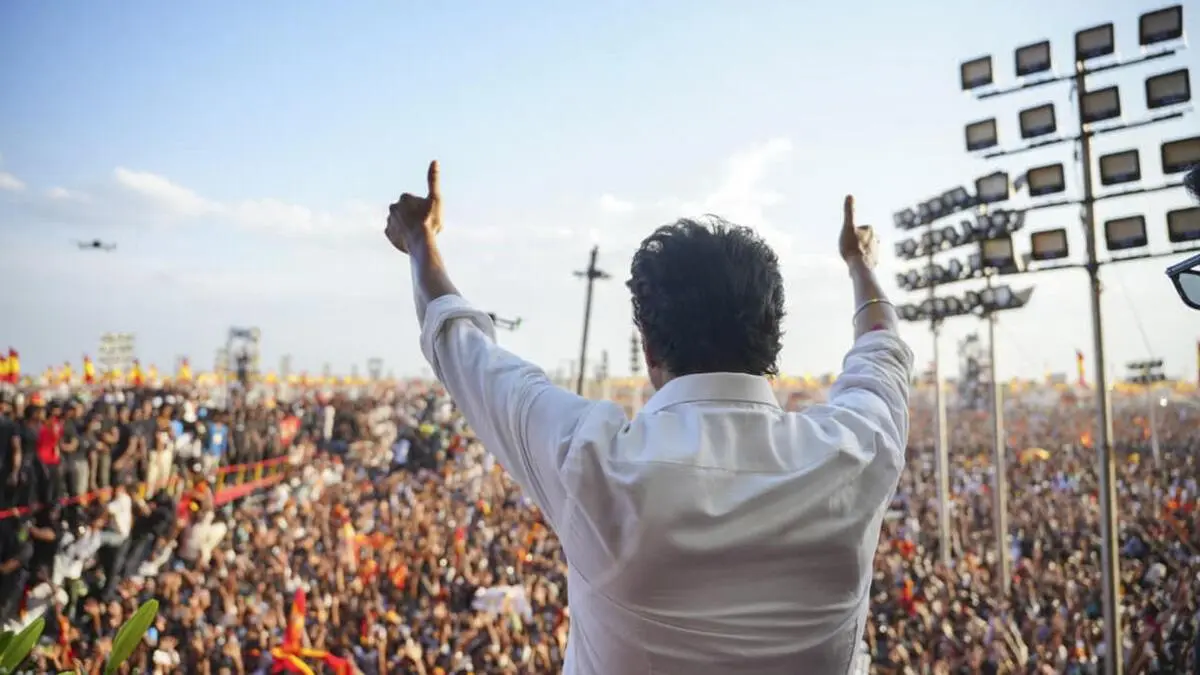
Just last year, on August 21, 2025, CM Joseph Vijay, then still the TVK party president, addressed the party’s second State-level conference in Madurai. The photos from that event, showing a sea of adoring supporters, now seem prophetic. It was a preview of the immense popular groundswell that would soon propel him to the highest office in the state.
The TVK Tsunami: A Political Earthquake
Winning 108 seats in the Tamil Nadu Assembly is no small feat. It represents a clear mandate, a decisive rejection of the established order. This wasn’t a narrow victory; it was a comprehensive reordering of power dynamics. The TVK’s triumph signals the deep desire among voters for something new, something different, something that promises a break from the past. It speaks to a disenchantment with the traditional Dravidian parties, perhaps perceived as having lost touch with the aspirations of a modern, digitally connected electorate.
Beyond the Ballot: The Rise of the ‘Influencer State’
This election isn’t just about who won; it’s about *how* they won and what that implies for democracy itself. Many are calling this the rise of the “influencer state.” In an age dominated by social media, direct communication, and curated personal brands, traditional political discourse might be losing its footing. Vijay’s charisma, his direct appeal to fans through digital channels and public gatherings, often bypassed the filters of traditional media and political analysis. His persona as a relatable superstar, untainted by decades of political baggage, resonated powerfully.
This model, where a celebrity leverages their massive following to create a political movement, raises intriguing questions. Is this the future of democracy, where political campaigns increasingly resemble content creation, and leaders function as super-influencers? The TVK’s success certainly points in that direction.
A New Era? The Crisis for Dravidian Ideology
The victory represents a profound challenge to the very foundation of Dravidian politics that has shaped Tamil Nadu for over half a century. The DMK and AIADMK, rooted in the Dravidian movement’s ideals of social justice, linguistic pride, and anti-caste sentiment, have defined the state’s political identity. The TVK’s win suggests that these traditional narratives, while still important, might no longer be sufficient to capture the imagination of a new generation of voters.
Is this a crisis for Dravidian politics? Many analysts believe so. It suggests a potential shift away from ideology-driven movements towards personality-driven leadership, raising questions about the future relevance of the historical underpinnings of Tamil Nadu’s political identity.
Public Reason on the Sidelines?
This shift also brings into focus the ideas of 20th-century philosopher Jürgen Habermas, who championed “communicative action” as the bedrock of true democracy. Habermas argued that a healthy democracy thrives on open, rational public debate, where ideas are scrutinized, arguments are exchanged, and informed consensus emerges. It’s a space of “public reason.”
The rise of the “influencer state,” however, potentially bypasses this traditional public sphere. When a leader’s appeal is built on charisma and direct connection, often bypassing detailed policy debate in favour of broad promises and emotional resonance, what happens to public reason? Does it diminish the space for critical engagement and informed decision-making, in favour of a more visceral, personality-driven political choice? The TVK’s victory invites us to ponder these crucial questions about the health and future of our democratic processes.
The Road Ahead for Tamil Nadu
For Chief Minister Joseph Vijay and the TVK, the real work begins now. Translating widespread popular support into effective governance, addressing complex policy challenges, and managing the expectations of a diverse electorate will be their ultimate test. Their victory has undoubtedly fractured the established order, signaling a brave new world for Tamil Nadu politics. The question remains: what kind of world will it be?
Why This Matters
The TVK’s win isn’t just a local story; it’s a national and global indicator of how celebrity power and digital influence are reshaping democratic processes. It challenges traditional political models, highlights voter fatigue with established parties, and forces us to reconsider what constitutes “public reason” in an era of direct, personalized communication. Tamil Nadu’s 2026 election is a case study in the evolving relationship between entertainment, politics, and the electorate, with implications far beyond its borders.