The recent news of Vijay Shankar’s retirement from all forms of cricket wasn’t a headline that sent shockwaves through the sporting world. Not because it wasn’t significant, but because for many, the “3D cricketer” had already faded into the background, a name whispered in the ‘what-if’ corners of Indian cricket. Yet, his story, particularly a tumultuous 75-day period in 2019, is a poignant reminder of the brutal realities and fleeting opportunities in elite sport.
The “3D” Tag and a World Cup Call-Up
For Vijay Shankar, the ultimate roller-coaster ride truly began on April 15, 2019. That’s the day the Board of Control for Cricket in India (BCCI) announced its squad for the ICC Cricket World Cup, and Shankar’s name was on it. But this wasn’t just any selection; it came at the expense of veteran batsman Ambati Rayudu, a decision that sparked a national debate. The chief selector, MSK Prasad, famously justified Shankar’s inclusion by praising his “three-dimensional” abilities: batting, bowling, and fielding.
Rayudu, understandably disappointed, retorted with a sarcastic tweet about buying “3D glasses” to watch the World Cup, cementing the ‘3D’ moniker to Shankar forever. It was a baptism by fire, placing immense pressure on a player still finding his feet on the international stage. But Shankar, ever the earnest professional, seemed to embrace the challenge, carrying the weight of expectation and a newly-minted nickname.
A Brief Glimpse of the Dream
The 2019 World Cup in England was supposed to be his moment. India’s elusive search for a dependable number four batsman had seemingly found its answer in Shankar. He was seen as a versatile option, capable of anchoring an innings or accelerating when needed, with his handy medium pace adding an extra dimension.
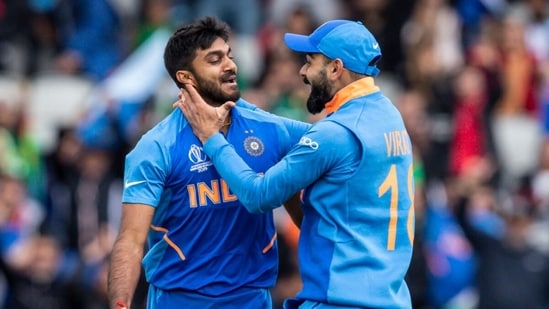
He played his part, albeit briefly. Who could forget the moment in the high-stakes match against Pakistan? Brought into the attack, he snared the wicket of Imam-ul-Haq with his very first delivery in World Cup cricket – a memory etched in the minds of fans and highlighted by a visibly thrilled Virat Kohli. He even chipped in with an unbeaten 29 against Afghanistan. The dream, though fragile, was taking shape.
The Cruel Twist of Fate: A “Suspicious” Injury
Then came the turning point, a moment that would derail his World Cup journey and, arguably, cast a long shadow over his international career. On July 1, 2019, just 75 days after his dramatic selection, Vijay Shankar was ruled out of the World Cup due to a toe injury. The official explanation was that he was hit on the toe by a Jasprit Bumrah yorker in a net session.
While injuries are a part and parcel of the game, the timing and the nature of the exit felt abrupt. “Suspicious injury” is how the original report put it, reflecting a sentiment among some that his exclusion felt sudden and final, particularly given the pressures and underperformance of the middle order at that point. He was replaced by Mayank Agarwal, and just like that, his World Cup adventure was over. He never played for India again.
The Long Road Back, and the Quiet Fade
The World Cup exit was more than just missing out on the biggest tournament; it marked the end of his consistent run in the national team. The recovery was slow, and the path back was arduous. Shankar, a player whose international career comprised a mere 12 ODIs and 9 T20Is, found himself on the fringes.
He continued to ply his trade in domestic cricket, always with the same earnestness that defined his brief international stint. He moved from his home state of Tamil Nadu to represent Tripura, showcasing his commitment to the game. In January, just five months before his retirement announcement, he reminded everyone of his capabilities, scoring an unbeaten 151 in a competitive match. It was a performance that showed he was far from “finished.”
Yet, the quiet retirement signals that the dream of a consistent international comeback had finally receded. Despite his efforts, the national selectors had moved on, and the memory of the “3D cricketer” became a distant echo.
Vijay Shankar: The Man Beyond the Moniker
Let’s be honest, Vijay Shankar was never the archetypal Indian all-rounder. He might not have possessed blistering pace, explosive power-hitting, or the kind of athleticism that consistently grabbed headlines. But what he lacked in raw, eye-catching talent, he made up for with pure heart and an unwavering dedication. He was, as the article hinted, a “pure soul,” approaching every game with a genuine desire to contribute.
His story is a testament to the immense pressures placed on Indian cricketers, especially those touted as potential solutions to long-standing problems. It’s a tale of how quickly fortunes can change, how a dream can ignite and extinguish within a mere 75 days, leaving behind a career defined by its potential and its quiet, unfulfilled promise.
Why This Matters
Vijay Shankar’s story isn’t just about one cricketer; it’s a window into the cutthroat world of international sport. It highlights the immense pressure, the fleeting opportunities, and the brutal impact of injuries that can define, or derail, a career. His journey reminds us that behind every statistic and headline, there’s a human story of aspiration, hard work, and the often-unseen struggles of athletes trying to carve out their legacy on the world stage. It’s a poignant lesson in how quickly dreams can be realized and then, just as suddenly, slip away.