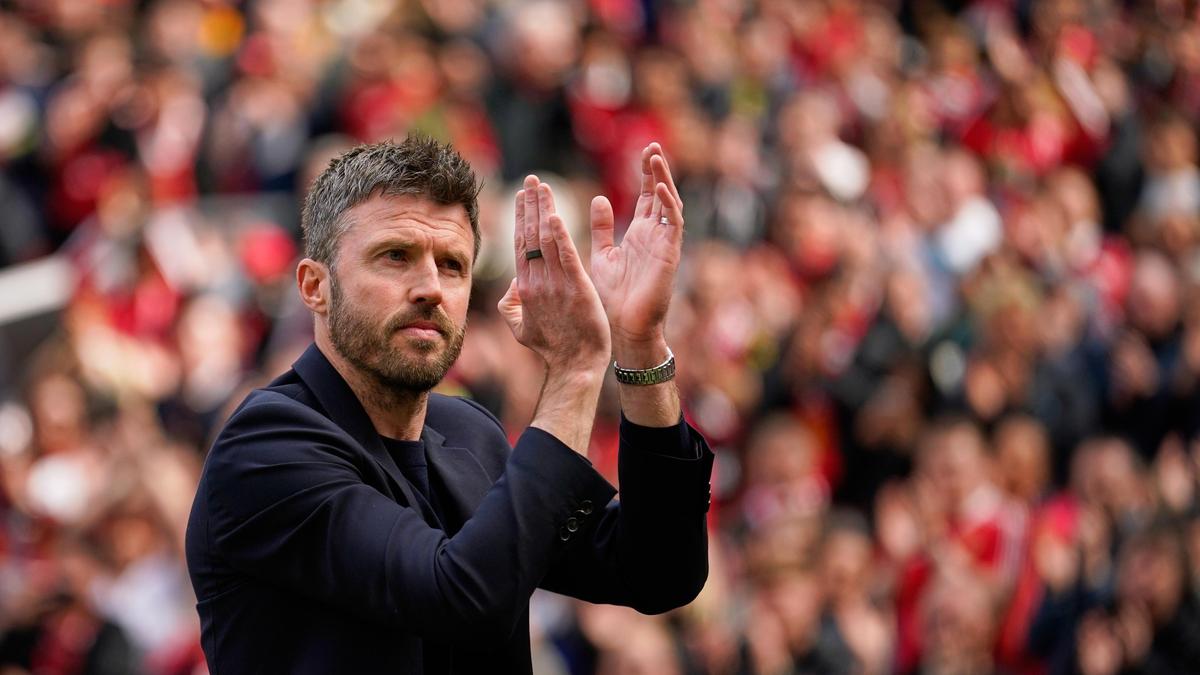
In a move that has sent ripples of anticipation and debate across the football world, Manchester United has officially appointed club legend Michael Carrick as its new head coach, signing him to a two-year contract. The news, quietly confirmed, signals a potentially defining shift in direction for a club consistently searching for stability and a return to its former glory.
The Prodigal Son Returns (to the Dugout)
For those who followed the beautiful game in the 2000s and 2010s, Michael Carrick is a name synonymous with understated brilliance. A masterful midfielder, Carrick spent 12 illustrious years at Old Trafford, winning five Premier League titles, the Champions League, the FA Cup, and multiple League Cups. He was the silent architect in the heart of Sir Alex Ferguson’s final great teams, known for his incredible vision, tactical intelligence, and calm demeanor under pressure.
After hanging up his boots, Carrick seamlessly transitioned into coaching, serving under José Mourinho, Ole Gunnar Solskjaer, and even taking the reins as caretaker manager for a brief, unbeaten spell. This deep-rooted connection, not just as a player but as a coach who understands the club’s inner workings, has clearly been a significant factor in his elevation to the top job. It’s a testament to United’s perceived desire to return to its ‘DNA’ – a philosophy often invoked but rarely consistently embodied in recent managerial appointments.
A New Chapter for Old Trafford?
Manchester United has endured a turbulent decade since Sir Alex Ferguson’s retirement, cycling through managers with varying degrees of success and tactical philosophies. The club has yearned for a consistent identity, a clear vision, and a figurehead who can connect with the fanbase on a deeper level. Carrick’s appointment could be seen as an attempt to bridge that gap.
His time as caretaker manager, though short, offered a glimpse into his potential. He navigated a difficult period with composure, earning positive results against Villarreal and Chelsea. This brief stint likely provided the club’s hierarchy with crucial insight into his leadership style, tactical acumen, and ability to command respect within the dressing room. His familiarity with the current squad, many of whom he coached or played alongside, is an undeniable asset, potentially allowing for a smoother transition.
What Does a Two-Year Deal Mean?
The two-year duration of Carrick’s contract offers an interesting talking point. In the high-stakes world of elite football, a two-year deal for a head coach at a club of United’s stature can be interpreted in several ways. It could be seen as a vote of confidence, offering him a reasonable window to implement his vision without immediate pressure for long-term commitment. It provides enough time to mold the squad, imprint a playing style, and hopefully deliver tangible improvements.
Alternatively, some might view it as a cautious approach – a ‘prove-it’ period, allowing both parties to assess the fit before committing to a longer-term future. Given the club’s recent managerial merry-go-round, a slightly shorter initial contract might be a strategic play to manage expectations and provide flexibility. Regardless of interpretation, it signifies a new era and a fresh challenge for Carrick, who now has the ultimate responsibility for guiding the Red Devils forward.
The Road Ahead: Challenges and Opportunities
The task awaiting Carrick is monumental. Manchester United is a club with global expectations, a demanding fanbase, and rivals who have, in recent years, established greater consistency. He will immediately face pressure to deliver results, establish a clear tactical identity, and make shrewd decisions in the transfer market to strengthen the squad.
The immediate priorities will likely include fostering a cohesive team spirit, refining the playing style, and ensuring the team can compete consistently at the highest level both domestically and in Europe. His ability to develop young talent, a hallmark of United’s philosophy, will also be under scrutiny. Success will not just be measured in silverware, but in the performance consistency and the entertainment value that fans crave.
Fan Pulse: A Mixed Bag of Hope and Caution
The reaction among the Old Trafford faithful is likely to be a blend of emotions. There will be undeniable excitement and nostalgia for one of their own taking the helm – a feeling that contrasts sharply with the detachment often associated with external appointments. This emotional connection can provide a valuable bedrock of support, especially during challenging periods.
However, there will also be a degree of caution. Coaching at this level is a relentless grind, and fans are acutely aware of the pitfalls. The hope will be that Carrick’s innate understanding of the club, combined with his recent coaching experience, will equip him to navigate the intense scrutiny and deliver the success that has eluded United for too long. His appointment represents a gamble, but one rooted in familiarity and a deep-seated belief in the club’s heritage.
Why This Matters
This appointment isn’t just another managerial change; it’s a powerful statement from Manchester United. By entrusting the head coach role to Michael Carrick, the club is leaning into its own history and internal expertise, rather than looking exclusively to established, external figures. It reflects a growing trend in football where clubs are increasingly willing to give opportunities to former players who understand the club’s culture intimately. For fans, it offers the tantalizing prospect of a return to core values and a fresh start under a beloved figure, signaling a potentially new direction for one of the world’s biggest football institutions.