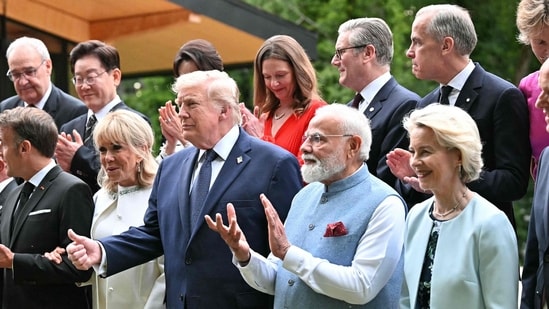
When the US President weighs in on a provincial election in a foreign land, you know it’s not just any ballot count. This month, the political world raised an eyebrow when the White House spokesman delivered Donald Trump’s congratulations to Prime Minister Narendra Modi, hailing his “historic and decisive election victory” in West Bengal. It was a moment that underscored not just a significant win for Modi’s BJP, but potentially a pivotal shift in the very fabric of Indian democracy.
A Win Heard ‘Round the World
It’s truly rare for a US President to comment on the outcome of a state-level election anywhere, let alone in India. The commendation from Washington to Delhi was therefore far more than a diplomatic courtesy; it was an acknowledgement of an electoral feat that had ramifications reaching beyond India’s borders. For Modi and his Bharatiya Janata Party (BJP), conquering West Bengal was no small feat, particularly given the state’s historically fierce resistance to the saffron party.
Bengal’s Seismic Shift
Just a decade ago, the BJP’s presence in West Bengal was, by most accounts, negligible. The state was a bastion of regional parties and, before that, a long-standing communist stronghold. Its unique political landscape and vibrant, often fiery, electoral culture seemed impenetrable. Yet, here we are in May 2026, witnessing the BJP’s triumphant flag flying high over Kolkata. This victory is nothing short of a political earthquake, transforming the state’s political identity and cementing the BJP’s dominant position on the national stage.
The Rise of a ‘One-Party State’?
The West Bengal win isn’t just a feather in Modi’s cap; it’s a critical piece in a much larger puzzle. With this latest conquest, the BJP now holds sway in 22 of India’s 28 states. This translates to an astonishing control over 73 percent of the country’s geographical area and approximately 78 percent of its 1.45 billion-strong population. Such overwhelming dominance by a single party is prompting serious discussions among political analysts and citizens alike: Is India, often celebrated as the world’s largest democracy, practically evolving into a one-party state?
Whispers of a ‘Managed Democracy’
This term, “managed democracy,” has been gaining traction in recent discourse, particularly in the wake of the West Bengal results. It describes a system where, while elections are held, the playing field is increasingly engineered to favour the ruling party. It’s a concept that suggests a democracy moving from being “flawed” to being “managed,” akin to models seen in other nations where electoral processes exist but their outcomes are, to a degree, pre-determined or heavily influenced.
The shift isn’t always overt; it’s often a subtle tightening of control that can make it incredibly difficult for opposition voices to gain traction. It involves a confluence of factors: strategic legislative changes, control over key institutions, and potentially, influence over the media narrative. The implications are profound for the health and vibrancy of democratic debate and dissent.
Electoral Integrity Under Scrutiny
Concerns over the integrity of the electoral process have also emerged, adding to the discussion around a “managed democracy.” A significant indicator of this sentiment was observed on April 7, 2026, in Balurghat, Dakshin Dinajpur district. Here, people were seen lining up to submit petitions before a Special Tribunal after their names were reportedly deleted from the final voter list. Such instances, where the very foundation of electoral participation – the right to vote – faces questions, fuel anxieties about fairness and transparency.
While voter list issues can sometimes be administrative, their prevalence and the need for special tribunals can raise red flags. In a “managed democracy,” such mechanisms, whether intended or not, can contribute to a sense that the electoral apparatus itself is being fine-tuned to achieve specific political outcomes. It’s a gradual erosion of trust in the system, where the rules of the game are perceived to be shifting.
Looking Ahead: The Future of Indian Democracy
The West Bengal election, therefore, stands as more than just a state victory. It’s a bellwether for the future trajectory of Indian democracy. The sheer scale of the BJP’s dominance, coupled with the emerging concerns about electoral processes, paints a complex picture. India’s global standing as a robust democracy could face re-evaluation if the perception of “managed democracy” takes deeper root. The vibrancy of its multi-party system, the freedom of its press, and the voice of its citizens are all critical elements that bear watching in the coming years.
Why This Matters
This story isn’t just about political power plays; it’s about the very essence of democratic governance in a nation of 1.4 billion people. When elections are perceived to be increasingly engineered, it erodes public trust, stifles dissenting voices, and fundamentally alters the relationship between citizens and their government. For India, a nation built on democratic ideals, this shift could reshape its future, impact its international standing, and determine the freedoms enjoyed by its vast population. It’s a development that demands attention, debate, and vigilance from every corner of society.