Deep within the administrative heart of Jammu and Kashmir, bound registers, some many decades old, still tell their stories in Urdu. These yellowing pages, meticulously documenting landholdings, inheritances, and disputes, are more than just records; they represent the very administrative memory and cultural fabric of the region. Now, this long-standing relationship between language and governance finds itself under an intense, modern spotlight.
The Spark: A Rule Change Ignites Debate
On April 10, a seemingly bureaucratic move by the Revenue Department, operating under Chief Minister Omar Abdullah, sent ripples through the region. Amended draft recruitment rules were released, notably removing Urdu as a mandatory qualification for recruitment to the department. While a specific departmental change, this decision has quickly been interpreted by many as a significant step in a larger, concerning trend.
The timing and nature of this policy adjustment immediately drew fire, particularly given the broader political context. For years, there has been an ongoing discussion, often contentious, about the role of language in Jammu and Kashmir. However, the recent shift is seen by many as part of a more deliberate effort by the BJP to reshape the region’s identity, often perceived as an attempt to dilute its Muslim-majority landscape and promote Hindi.
Protest and Political Outcry
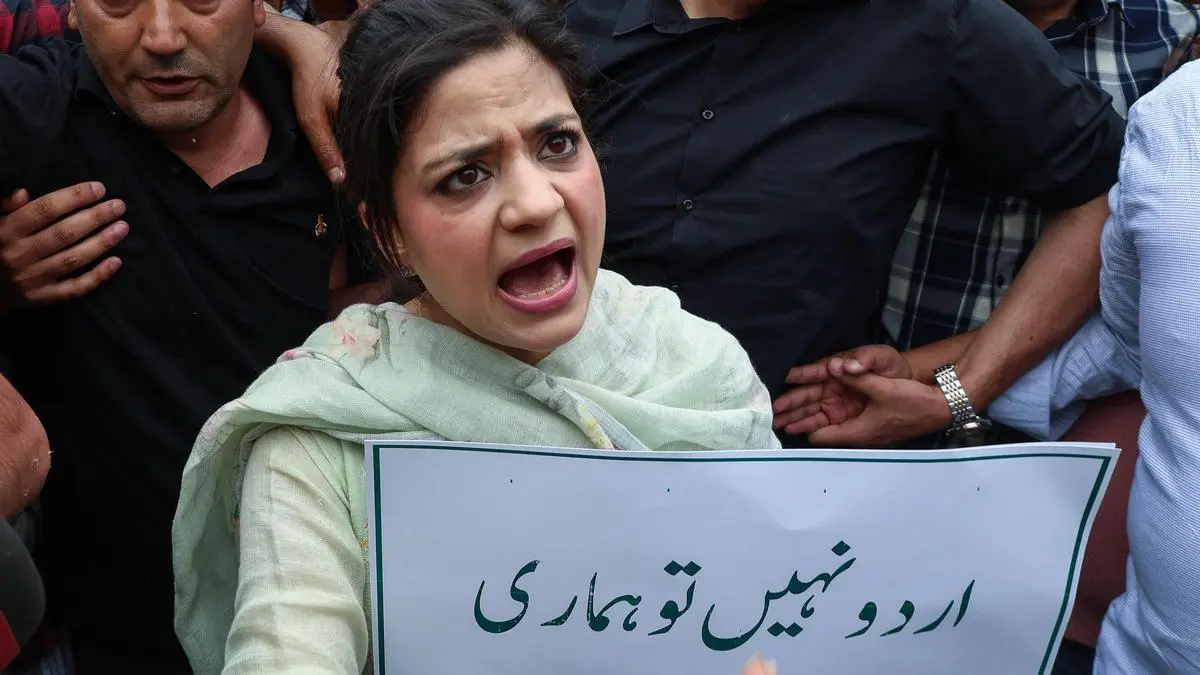
The response was swift and vocal. Just over two weeks later, on April 28, People’s Democratic Party (PDP) leader Iltija Mufti spearheaded a protest in Srinagar. Her message was clear: this move was not just an administrative tweak but an attack on the cultural and linguistic heritage of Jammu and Kashmir. The images of her leading the charge against the decision underscored the deeply emotional and political dimensions of the issue.
Mufti’s protest wasn’t an isolated incident; it resonated with many who view the mandatory requirement of Urdu for administrative posts as a safeguard for the language’s vitality. The fear is that by removing this prerequisite, the incentive to learn and use Urdu, especially among younger generations aspiring for government jobs, will diminish significantly.
Urdu’s Deep Roots in Kashmir
To understand the weight of this change, one must appreciate Urdu’s indispensable role in Jammu and Kashmir’s linguistic mosaic. Beyond administrative records, Urdu has historically served as a lingua franca, bridging communities and fostering a shared cultural identity. It’s the language of poetry, literature, and everyday communication for a substantial portion of the population.
Its official status in the region is not merely ceremonial; it has been foundational to how the government functions, how legal documents are drafted, and how citizens interact with public services. Removing its mandatory status in key administrative sectors like the Revenue Department, which deals directly with citizens’ most fundamental assets – land – is thus perceived as more than just an operational change; it’s seen as chipping away at a core aspect of Kashmiri life.
The Bigger Picture: A “Quiet Erasing”?
The current debate isn’t just about one department’s recruitment rules. It’s situated within a broader narrative, as the initial article suggests, of a “quietly erasing” of Urdu from Kashmir’s administrative and cultural life. Critics argue that such policy shifts, even when implemented by local administrations (like Omar Abdullah’s government in this specific instance), contribute to a larger political project designed to alter the region’s socio-cultural fabric.
This project, often attributed to the BJP’s long-term strategy for Jammu and Kashmir, aims to consolidate a particular vision of national identity that some fear marginalizes regional languages and cultural specificities in favor of a more homogenized, Hindi-centric approach. For many Kashmiris, the gradual undermining of Urdu is not just a linguistic concern but a perceived threat to their distinct cultural identity and historical continuity.
Implications for Future Generations
The ripple effects of such a policy could be profound. If Urdu is no longer a prerequisite for government jobs, what does this mean for its future? Will schools and families prioritize its learning? The fear is a slow but steady decline in its usage and proficiency, eventually leading to a generation less connected to the language that once bound their history and administration.
This isn’t merely an academic concern; it has practical implications for governance itself. With decades, if not centuries, of records maintained in Urdu, a workforce less proficient in the language could complicate access to historical data, land records, and legal precedents. It raises questions about continuity, accessibility, and the practical challenges of transitioning away from a deeply embedded linguistic system.
Why This Matters
This isn’t just a local squabble over language. It’s a high-stakes cultural battle with significant implications for identity, governance, and the very soul of a region. The debate over Urdu in Kashmir highlights the delicate balance between national policy and regional heritage, underscoring how administrative decisions can have far-reaching impacts on a community’s sense of self. It’s a reminder that language is never just a tool for communication; it’s a repository of history, a carrier of culture, and a cornerstone of identity, especially in a region as historically complex as Jammu and Kashmir.