
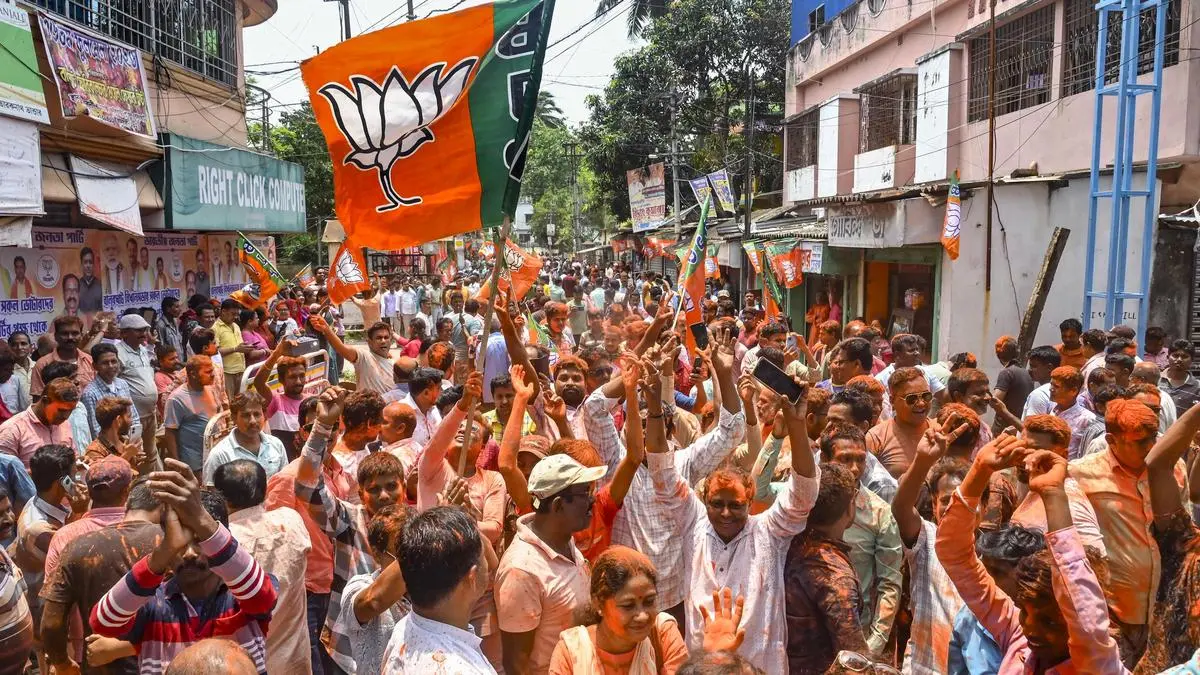
The recent West Bengal Assembly election results sent ripples across the nation, with the Bharatiya Janata Party (BJP) securing a stunning landslide victory. Bagging 207 seats and a formidable 45.8 per cent vote share, the sheer scale of their triumph left many political pundits and observers scratching their heads, labelling it a ‘surprise’. But what if this wasn’t a surprise at all? What if Bengal’s political history itself laid the groundwork for such a decisive mandate?
Unpacking the ‘Surprise’ Element
On the surface, the BJP’s overwhelming win – shifting the state’s political landscape dramatically – certainly felt like a seismic event. Predictions varied wildly, with many anticipating a much tighter contest, a hard-fought battle where every seat would count. The narrative often focused on the intense rivalry, the high stakes, and the perception of a deeply divided electorate. Yet, when the dust settled on May 4, 2026, the numbers told a different story – one of clear, undisputed dominance by the winning party.
Bengal’s Undeniable Landslide Legacy
Delving into West Bengal’s electoral past reveals a fascinating and consistent pattern: the state’s voters have an uncanny habit of delivering landslide victories. This isn’t a new phenomenon; it’s a deep-rooted characteristic of Bengal’s democratic process stretching back decades. Looking at Assembly election data since 1972, a powerful trend emerges: the winning party almost invariably secures a substantial share of both seats and votes, often far exceeding the simple majority mark.
Political analysts Sanjay Kumar, Vibha Attri, and Arindam Kabir highlight this historical continuity. They point out that, with only a few exceptions, the proportion of seats won by the ruling party has consistently been well above 50 per cent. This isn’t about small margins; it’s about powerful, sweeping mandates that leave little room for ambiguity.
A History of Dominant Majorities
Consider the political epochs Bengal has witnessed. From the long reign of the Left Front, which held power for over three decades, to the Trinamool Congress’s ascendance, each dominant force enjoyed not just victory, but resounding, unchallengeable majorities. Voters, it seems, have a preference for handing over the reins decisively, granting the chosen party a robust mandate to govern. This historical tendency suggests that once a party gains momentum and trust, it’s often rewarded with an emphatic win rather than a narrow escape.
This electoral behaviour reflects a unique dynamic within the state’s political psyche. Perhaps it’s a desire for strong, stable governance, or a clear rejection of perceived inefficiencies, but the outcome is almost always a powerful endorsement of one party over all others. The idea of a hung assembly or a coalition government has been a rare occurrence in Bengal’s modern electoral history, further cementing this ‘landslide pattern’.
The BJP’s Turn in the Spotlight
In this context, the BJP’s 2026 victory, securing 207 seats with 45.8% of the vote, simply becomes the latest, albeit significant, chapter in this ongoing narrative. Rather than an anomaly, it aligns perfectly with Bengal’s established electoral behaviour. The party, having built its base and campaigned vigorously, was ultimately granted the kind of overwhelming mandate that its predecessors also received. It shows that when the electorate decides to shift its allegiance, it does so with conviction and scale.
The magnitude of the BJP’s win, therefore, might have caught many off guard due to the prevailing national political discourse or immediate expectations, but it was, in essence, a classic Bengal outcome. The voters once again demonstrated their penchant for delivering a clear, unambiguous verdict, bestowing a powerful mandate upon the party they chose to lead.
Why This Matters
Understanding West Bengal’s unique landslide pattern is crucial for anyone trying to decipher Indian politics. It reveals that electoral outcomes aren’t always about marginal gains or neck-and-neck races, but can reflect a deeper, historical inclination of voters to back a winning party with overwhelming force. For the BJP, this robust mandate means a clear runway for implementing its agenda, while for the opposition, it signals the need for a fundamental re-evaluation of strategies to contend with such a decisive electorate. It’s a reminder that every state has its own electoral rhythm, and Bengal’s beats to the drum of decisive majorities.