## Key Takeaways
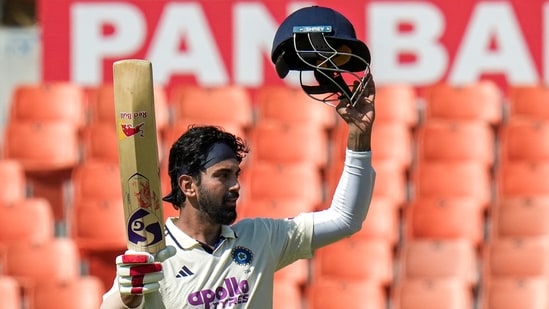
– KL Rahul scored his 12th Test century, contributing to India’s strong position against Afghanistan.
– The Indian captain admitted to experiencing a “T20 hangover” after a recent shift from the fast-paced format.
– Rahul’s hundred came just two weeks after his last competitive match in the Indian Premier League.
## Main Developments
New Delhi – Indian captain KL Rahul marked his return to Test cricket with a commanding 12th century, steering India to a dominant position on the opening day of the one-off Test against Afghanistan. The match, held at the New Chandigarh Stadium on Saturday, June 6, 2026, saw India finish the day strongly at 368 for three, with Rahul remaining unbeaten on 103 runs alongside Rishabh Pant, who reached 50 not out.
Rahul’s impressive knock followed a candid admission that he was grappling with a “T20 hangover” during his innings. Having spent the preceding weeks immersed in the Twenty20 format, primarily for the Delhi Capitals in the Indian Premier League (IPL) since early April, the transition to the demands of Test cricket presented a unique mental and technical challenge. The gap between his last T20 fixture and this Test match was a mere two weeks, highlighting the tight schedule and rapid format switching professional cricketers often navigate.
Speaking about his mindset, Rahul acknowledged the persistent urge to play aggressive shots, typical of the T20 game. However, he also viewed this inclination not as a detriment but as a part of his adaptable approach. This honesty offers a rare glimpse into the mental adjustments top-tier cricketers must make as they oscillate between the various forms of the sport, each demanding a distinct temperament and technique.
The shift from the exhilarating, boundary-driven T20 game to the meticulous, patience-oriented Test arena is one of modern cricket’s most formidable challenges. In T20s, a batsman is encouraged to take risks and accelerate scoring from the outset, often prioritizing quick runs over defensive solidity. Test cricket, conversely, demands sustained concentration, rigorous defence, and the ability to build an innings over hours, often across multiple sessions. For a player like Rahul, who excels in both formats, recalibrating his instincts from T20’s instant gratification to Test cricket’s marathon endurance is a testament to his skill and mental discipline.
His innings was crucial in setting a robust foundation for India. Partnering with Shubman Gill, who also reached a century, Rahul helped forge a substantial first-day total that puts India in a commanding position. The partnership underscored India’s batting depth and their ability to dictate terms early in the match. Achieving a century in Test cricket is always a significant milestone, but for Rahul, this particular hundred carries added weight, demonstrating his capacity to overcome the psychological residue of a different format and perform at the highest level.
The modern cricketing landscape increasingly requires players to be multi-faceted, capable of switching gears seamlessly between international commitments and franchise leagues. This constant flux, while enriching the sport globally, places immense pressure on athletes to adapt quickly. Rahul’s performance, therefore, not only highlights his individual talent but also serves as a prime example of the resilience and mental fortitude demanded from contemporary cricketers navigating such diverse schedules. His ability to channel his T20 instincts productively, rather than letting them hinder his Test approach, speaks volumes about his professional acumen and understanding of his own game.
The strong close to Day 1, with both Rahul and Pant at the crease, sets India up for a potentially massive first-innings total, which could prove decisive in this one-off Test match. The focus will now shift to consolidating this advantage and putting Afghanistan under sustained pressure as the game progresses.
## Why This Matters
KL Rahul’s candid admission about a “T20 hangover” provides valuable insight into the unique mental and technical challenges faced by modern cricketers who routinely transition between different formats of the game. It highlights the significant adaptability and mental fortitude required to excel in both the explosive T20 arena and the strategic, endurance-driven world of Test cricket. His ability to score a crucial century despite this admitted internal struggle underscores his professionalism and skill, serving as an inspiration for aspiring athletes navigating multi-format demands. This scenario also sheds light on the broader implications of dense cricketing schedules for player performance and mental well-being, emphasizing the constant adjustment needed at the elite level.
## Frequently Asked Questions
1. What significant milestone did KL Rahul achieve recently?
KL Rahul scored his 12th Test century for India during a one-off match against Afghanistan at the New Chandigarh Stadium.
2. What challenge did KL Rahul admit to facing during his Test innings?
Rahul admitted to experiencing a “T20 hangover,” meaning he felt the urge to play shots characteristic of the T20 format, having recently played in the Indian Premier League.
3. How recently had KL Rahul been playing T20 cricket before this Test match?
He had concluded his competitive T20 cricket for Delhi Capitals in the Indian Premier League just two weeks prior to the Test, having been involved in the T20 format since early April.