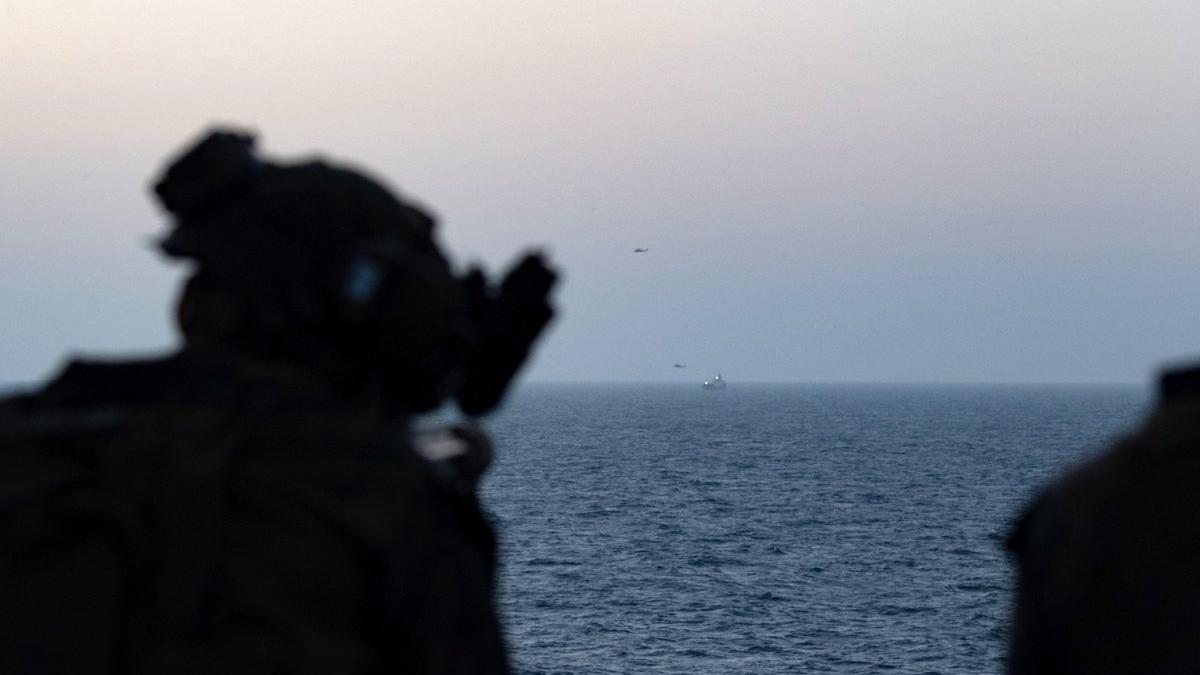
A dramatic report from Iranian state-affiliated media has sent ripples across international news desks, claiming that missiles were fired at a U.S. frigate in the notoriously volatile Strait of Hormuz. The allegations, if true, mark a significant and dangerous escalation in an already tense region. As of now, U.S. officials have not confirmed or denied the incident, leaving a vacuum of official information that fuels speculation and concern.
The Allegation Unpacked
According to reports circulating on Iranian news channels and social media platforms linked to the Islamic Revolutionary Guard Corps (IRGC), the alleged incident occurred early Monday morning. Specific outlets, such as Tasnim News Agency and Fars News, cited “informed sources” claiming that “warning missiles” were launched in the vicinity of a U.S. Navy vessel identified as a frigate. Details regarding the exact type of missile, the distance from the U.S. vessel, or any reported damage remain sparse and unverified. Some accounts suggest the missiles were fired as a “demonstration of force” following what Iranian sources described as “provocative maneuvers” by the American warship. However, these claims lack independent corroboration.
The reports paint a picture of a calculated move, aimed at signaling Iran’s assertiveness in waters it considers strategically vital. Without official confirmation from Washington, the narrative remains firmly in the realm of Iranian media claims, which often serve a dual purpose of domestic messaging and international posturing.
U.S. Silent So Far
The Pentagon and the U.S. Navy’s Fifth Fleet, which operates in the Middle East, have maintained a noticeable silence regarding the Iranian claims. Typically, the U.S. military is quick to address reports of direct engagements or significant threats to its assets. This lack of immediate response could indicate several things: an ongoing assessment of the situation, a deliberate strategy to avoid dignifying the claims, or that the incident, as described by Iran, did not occur or was not deemed significant enough to warrant public comment.
Journalists have reached out to U.S. defense officials for clarification, but as of this writing, no official statement has been issued. This silence only amplifies the uncertainty surrounding the reported event and keeps observers guessing about the true state of affairs in the critical waterway.
Hormuz: A Global Flashpoint
The Strait of Hormuz is one of the world’s most strategically important chokepoints. Nestled between Iran and Oman, this narrow waterway connects the Persian Gulf to the open ocean, serving as the transit route for approximately one-fifth of the world’s total oil consumption and a significant portion of global liquefied natural gas (LNG) shipments. Any disruption or escalation of tensions here has immediate and far-reaching implications for global energy markets and international trade.
Both the U.S. and Iran maintain a significant naval presence in the region, leading to frequent close encounters and occasional skirmishes. International law guarantees freedom of navigation through the strait, a principle the U.S. steadfastly upholds, often to the ire of Iran, which views the presence of foreign military forces as a threat to its sovereignty.
A Volatile History
Incidents involving U.S. and Iranian forces in the Strait of Hormuz and surrounding waters are not uncommon. Over the years, there have been numerous reports of near-misses, warning shots, and detentions of foreign vessels. From Iranian fast boats harassing U.S. warships to the seizure of oil tankers and the downing of drones, the region has a long and troubled history of tit-for-tat actions.
Just a few years ago, attacks on oil tankers in the Gulf of Oman, widely attributed to Iran, sent shockwaves through the international community. These past events underscore the hair-trigger nature of the security environment and highlight how easily miscalculation or misinterpretation could lead to a broader conflict. Against this backdrop, even an unconfirmed report of missile fire carries significant weight.
Potential Fallout and the Need for Verification
Should the Iranian claims prove to be accurate, even if the missiles were warning shots or did not cause damage, such an action would be a serious provocation. It would likely be interpreted as an aggressive move designed to test the resolve of the U.S. and its allies, potentially leading to increased naval patrols, heightened alert levels, and a renewed cycle of rhetoric and countermeasures.
Conversely, if the claims are fabricated or exaggerated, they still serve a purpose for Iran – both domestically, by projecting an image of strength, and internationally, by keeping regional adversaries and global powers on edge. The challenge for international media and policymakers now lies in discerning fact from propaganda, a task made increasingly difficult by the opaque nature of regional information flow.
Why This Matters
This unconfirmed report, whether true or not, underscores the fragility of peace in one of the world’s most critical geopolitical hotspots. The Strait of Hormuz is not just a shipping lane; it’s a barometer of U.S.-Iran relations and a bellwether for global economic stability. Any hint of direct military engagement, even a claim, has the potential to ripple through oil markets, escalate diplomatic tensions, and increase the risk of a wider conflict. The world watches and waits for official confirmation or denial, understanding that in this part of the globe, even whispers can ignite a fire.